O.O usually means a surprised, confused, shocked, or “what just happened?” facial expression in text. It is an emoticon made from two eyes, and people use it in texting and on platforms like TikTok, Snapchat, Instagram, and WhatsApp to show a reaction.
You may come across O.O while chatting with someone, reading a comment, or scrolling through social media. At first glance, it can look like a random combination of letters and punctuation, especially if you’re not familiar with older internet emoticons.
The meaning usually depends on the conversation. Someone might send “O.O” because they are surprised by what you said, confused about a situation, or simply reacting as if they have just seen something unexpected.
If you’ve searched for what does O.O mean in text, you’re probably trying to figure out whether the person was confused, shocked, joking, or reacting negatively. The good news is that O.O is generally harmless and is mostly used as a visual reaction.
O.O Meaning in Text
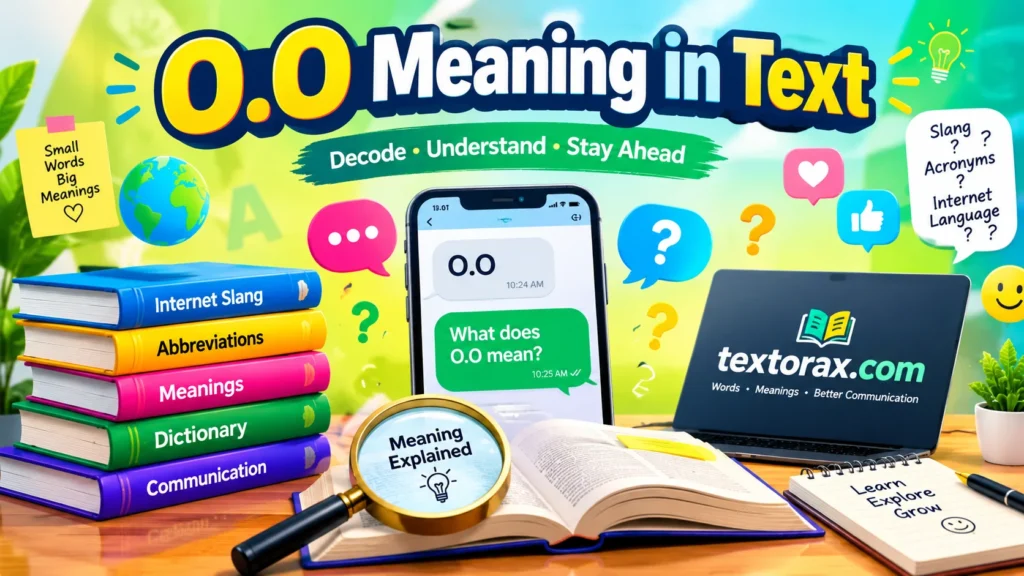
In texting, O.O represents a facial expression showing wide or surprised eyes.
Think of it as someone staring at something with a look of surprise:
O.O
The two “O” characters look like wide-open eyes. The dots or punctuation between them can be interpreted as the space between the eyes or part of the emoticon’s expression.
Depending on the situation, O.O can communicate several similar feelings:
- Surprise
- Shock
- Confusion
- Disbelief
- Curiosity
- Awkwardness
- “Wait, what?”
- “Did I just read that correctly?”
- “I wasn’t expecting that.”
It is not normally an acronym. Instead, O.O is an emoticon, meaning a combination of ordinary keyboard characters used to represent a facial expression or emotion.
This is an important distinction. Abbreviations such as “IDK” shorten words, while O.O is more like a tiny picture made from text.
For example:
Person A: “I accidentally sent the screenshot to my boss.”
Person B: “O.O”
Here, O.O basically means, “Oh wow. You actually did that?”
Is O.O the same as an emoji?
Not exactly.
O.O is a text-based emoticon, while emojis are graphical characters such as 😮, 😳, or 👀.
The closest emoji depends on the context. Someone using O.O might be expressing something similar to:
- 😮 — surprised
- 😳 — shocked or embarrassed
- 👀 — looking or paying attention
- 🤨 — confused or questioning
However, O.O has its own internet-culture feel. It can sound more playful, quirky, or deliberately old-school than simply sending a modern emoji.
What does O.O mean in everyday chat?
In everyday conversation, O.O usually means something like:
“Whoa.”
“What?”
“Seriously?”
“I didn’t expect that.”
“I’m confused.”
The exact meaning comes from the message around it.
For example, if someone says, “I just bought a car without taking it for a test drive,” a reply of “O.O” could communicate surprise or disbelief.
If someone tells you a confusing story, O.O might mean, “I’m trying to understand what I’m hearing.”
So don’t treat it as having one rigid definition. It is primarily a reaction.
Where People Use O.O
O.O can appear almost anywhere people communicate casually online. It is especially associated with informal internet conversations rather than professional communication.
O.O on TikTok
On TikTok, O.O may appear in comments when someone reacts to a surprising, strange, awkward, or unexpected video.
For example:
“He really said that on camera 😭 O.O”
Here, O.O adds a visual reaction to the person’s disbelief.
TikTok comments often mix traditional text emoticons with emojis, slang, abbreviations, and memes. Because of that, you might see O.O used either seriously or humorously.
Sometimes people use it simply because the expression looks funny.
O.O on Snapchat
Snapchat conversations are generally informal, so O.O can fit naturally into a message between friends.
Someone might send it after hearing unexpected news:
“You got tickets for tomorrow?? O.O”
In this situation, the person is surprised and probably wants more information.
The tone isn’t necessarily negative. It can simply show that something caught them off guard.
O.O on Instagram
On Instagram, you might see O.O in comments, DMs, captions, or replies.
For example:
“O.O what did I just watch?”
A person might use it after seeing a strange video, surprising post, unusual outfit, unexpected announcement, or funny situation.
Because Instagram has a mix of emojis and text-based communication, O.O isn’t unusual in casual interactions.
O.O on WhatsApp
On WhatsApp, O.O can be used in one-on-one chats and group conversations.
For example:
“O.O you finished the entire project in one night?”
It expresses surprise without requiring a full sentence.
People who already understand emoticons may use O.O naturally, while younger users may choose an emoji instead.
O.O in SMS
O.O can also appear in ordinary text messages, although it is less common than emojis on modern phones.
Someone might text:
“O.O I thought you were still at work.”
The meaning is essentially, “Whoa, I didn’t know that.”
Because standard SMS conversations are now heavily influenced by emojis and social media language, traditional emoticons like O.O are less dominant than they once were.
Real Chat Examples
Seeing O.O in actual conversations makes the meaning much easier to understand. Here are some realistic examples.
Example 1: Unexpected news
A:
Guess what? I quit my job today.
B:
O.O
A:
Yeah… I finally did it.
Here, B is surprised and probably wants to know what happened.
Example 2: Funny mistake
A:
I accidentally replied “love you” to my teacher.
B:
O.O
A:
Don’t laugh. I’m actually dying.
In this case, O.O shows shock and disbelief.
Example 3: Surprising achievement
A:
I finished the whole assignment in two hours.
B:
O.O
A:
I know. I’m shocked too.
The reaction means something close to “Wow, really?”
Example 4: Confusing story
A:
So he came to my house, borrowed my laptop, and then disappeared.
B:
O.O
A:
Exactly. I have no idea what happened.
Here, O.O communicates confusion.
Example 5: Unexpected purchase
A:
I just bought a motorcycle.
B:
O.O
A:
I’ve wanted one forever!
The reaction is mainly surprise.
Example 6: Strange social media post
A:
Did you see Sarah’s latest video?
B:
No, why?
A:
Just watch it.
B:
O.O
The final reaction suggests the video was strange, shocking, or unexpected.
Example 7: Awkward situation
A:
He asked me out in front of everyone.
B:
O.O
A:
I didn’t know what to say.
Here, O.O expresses surprise and perhaps secondhand awkwardness.
Example 8: Unexpected score
A:
I got 98 on the exam.
B:
O.O
A:
Don’t sound so surprised 😂
The reaction is playful rather than negative.
Example 9: Disbelief
A:
She ate six slices of pizza by herself.
B:
O.O
A:
I’m not even joking.
O.O means, “Seriously? Six?”
Example 10: Sudden confession
A:
Okay, I have something to tell you.
B:
What?
A:
I’ve liked you for months.
B:
O.O
Here, the emoticon communicates being caught completely off guard.
How to Reply When Someone Says “O.O”
Your response depends on why the person used it.
If they’re surprised, you can explain what happened.
Funny replies
If the conversation is playful, you could respond with:
- “Yep. You read that correctly 😂”
- “Don’t look at me like that 😂”
- “That face says everything.”
- “I knew you’d react like that.”
Casual replies
For an ordinary conversation, keep things simple:
- “Haha, yeah.”
- “I know, right?”
- “Seriously!”
- “Yep, that’s what happened.”
- “Long story 😂”
Friendly replies
If you want to keep the conversation warm:
- “Haha, I surprised you!”
- “I can explain.”
- “Wait until you hear the rest.”
- “Trust me, I was surprised too.”
- “Let me tell you what happened.”
Neutral replies
If you aren’t sure about their tone, use a straightforward response:
- “What do you mean?”
- “Did that surprise you?”
- “I can explain.”
- “Is something wrong?”
- “Are you confused?”
There’s no need to overthink the response. O.O is usually just a quick emotional reaction.
Is O.O Rude or Offensive?
No, O.O is generally not rude or offensive.
It is normally a harmless emoticon used to express surprise, confusion, or disbelief.
However, tone still matters.
If someone tells you something serious and you respond only with “O.O,” they might interpret it as you being shocked, confused, or unsure how to respond. In some situations, that could come across as dismissive.
For example, if a friend says:
“I’m having a really difficult day.”
Replying:
“O.O”
would probably feel strange because the expression doesn’t clearly communicate support.
A better response would be something like:
“Oh no, what happened?”
Is O.O safe to use?
Generally, yes.
There is no common offensive meaning attached to O.O in ordinary texting. It is much closer to a reaction emoji than an insult.
Can you use O.O at school?
In casual messages with friends, sure.
But if you’re writing an essay, school assignment, formal email, or academic response, an emoticon like O.O usually doesn’t belong there.
Can you use O.O at work?
It depends on the workplace and the person you’re talking to.
In a casual team chat, it may be perfectly fine. In a formal email to a manager, customer, professor, or client, it’s better to use normal words.
Instead of:
“O.O What happened?”
a professional message could say:
“That was unexpected. Could you explain what happened?”
The meaning is clearer and more appropriate for a formal setting.
Who Uses This Term?
O.O is mostly associated with people who spend time in informal online communities, gaming spaces, forums, social media, and messaging apps.
Younger internet users
Younger users may understand O.O but not necessarily use it frequently. Modern emojis have replaced many older text emoticons in everyday messaging.
Still, O.O can appear when someone wants to create a particular internet-style reaction.
Gen Z usage
Gen Z users are familiar with a huge range of online expressions, including abbreviations, emojis, memes, and older internet slang.
O.O may show up in Gen Z conversations, but it isn’t necessarily one of the most frequently used expressions. Its popularity can vary significantly depending on the community.
Some people use it ironically because it has an old-school internet feel.
Gaming communities
You may encounter O.O more often in gaming chats, online communities, Discord-style conversations, or forums where text-based expressions have traditionally been popular.
A player might write:
“O.O how did you survive that?”
Here, the emoticon simply emphasizes surprise.
How often does O.O appear online?
It is recognizable, but it isn’t as universally common as expressions such as “LOL,” “IDK,” or modern emojis.
That’s partly because smartphones make it extremely easy to send a facial emoji instead.
Even so, O.O continues to appear because internet language doesn’t completely replace old expressions. Different communities keep their own styles alive.
Origin of the Term
The exact origin of O.O is difficult to pin down to one person, website, or specific date.
It belongs to the broader tradition of ASCII and text-based emoticons, where people used keyboard characters to create facial expressions before graphical emojis became widespread.
The basic idea is simple: letters and punctuation can visually resemble facial features.
For example:
- 🙂 can suggest a smile
- 🙁 can suggest sadness
- :O can suggest surprise
- O.O can suggest wide-eyed surprise or confusion
O.O likely developed through the same internet culture that produced countless variations of text faces.
Its exact meaning has never been completely standardized. Different online communities may interpret the characters slightly differently.
That’s why context matters so much.
One person may use O.O to mean “I’m shocked.”
Another may use it to mean “What are you talking about?”
Someone else may use it simply because they think the face looks funny.
The important point is that O.O comes from visual internet communication, rather than being a conventional acronym.
O.O vs. Other Common Text Abbreviations
O.O is different from many popular texting abbreviations because it represents an expression rather than shortening a phrase.
| Term | Meaning | Type | Usage | Popularity |
|---|---|---|---|---|
| O.O | Surprise, confusion, disbelief | Emoticon | Casual chats and online reactions | Moderate/less common |
| IDK | I don’t know | Abbreviation | Everyday texting and social media | Very common |
| IDC | I don’t care | Abbreviation | Casual conversations | Very common |
| IMO | In my opinion | Abbreviation | Discussions, comments, messages | Common |
| BRB | Be right back | Abbreviation | Chats and messaging | Common, though somewhat old-school |
The biggest difference is that O.O isn’t built from the first letters of a phrase.
IDK comes from “I Don’t Know.”
IDC comes from “I Don’t Care.”
IMO comes from “In My Opinion.”
BRB comes from “Be Right Back.”
O.O, on the other hand, is intended to look like a face.
Real-World Usage Example
Imagine you’re chatting with a friend after school.
You tell them that another friend unexpectedly won a major competition despite never having participated before.
Your friend might respond:
“O.O Wait, seriously?”
In this situation, the O.O isn’t meant to communicate anger or disrespect. It’s simply a quick visual representation of surprise.
Another situation could happen in a group chat.
Someone announces:
“Guys, I just found out tomorrow’s class was canceled.”
Someone else replies:
“O.O No way.”
Here, the emoticon reinforces the surprise in the message.
This is what makes expressions like O.O useful. Instead of writing a longer sentence such as “I’m extremely surprised by this information,” the person can use two characters to show their immediate reaction.
Of course, modern users can accomplish the same thing with an emoji. A message like “😮 No way” communicates almost the same idea.
The choice usually comes down to personal style and the culture of the conversation.
Frequently Asked Questions
What does O.O mean in text messages?
O.O is a text emoticon that usually expresses surprise, confusion, shock, or disbelief. It looks like a pair of wide-open eyes.
What does O.O mean on TikTok?
On TikTok, O.O is usually used as a reaction to something surprising, strange, awkward, or unexpected. Its exact meaning depends on the comment and video.
Is O.O slang?
O.O is better described as an emoticon rather than traditional slang. It uses text characters to represent a facial expression.
Is O.O rude or offensive?
Generally, no. O.O is considered harmless and isn’t normally offensive. However, using it in response to a serious message may seem dismissive or inappropriate.
How should you reply to O.O?
You can respond based on the situation. Try “I know, right?”, “Haha, yeah,” or “Did that surprise you?” if the person seems shocked or confused.
Final Thoughts
So, what does O.O mean in text? In most conversations, it represents a wide-eyed reaction to something surprising, confusing, shocking, or unexpected.
It’s a text-based emoticon rather than an acronym. The two “O” characters are meant to look like wide-open eyes, giving the message a visual reaction.
You might see it on TikTok, Snapchat, Instagram, WhatsApp, in gaming communities, or in ordinary text messages. Its popularity isn’t as high as common abbreviations like IDK or LOL, but people still use it, especially when they want an old-school or playful internet tone.
The most important thing is context. If someone sends “O.O”, don’t automatically assume they’re angry or offended. In most cases, they’re simply saying something like “Whoa,” “Really?” or “What’s going on?”
For casual conversations with friends, O.O is generally safe to use. For schoolwork, professional emails, or serious discussions, however, it’s usually clearer to express your reaction with actual words.
Discover More Post
What Does atp meaning in Text? Real Meaning Examples & Social Media Use 2026
What Does JSP Mean in Text? Real Meaning Examples & Social Media Use 2026